
Brünnich’s Guillemot
Brünnich’s Guillemot At a Glance
| Scientific Name | Uria lomvia |
| Population | Estimated at 15–20 million globally |
| Regions | Arctic and sub-Arctic regions of the Northern Hemisphere |
| Destinations | Jan Mayen, Iceland, Canada, Svalbard, Greenland, Norway |
| Average Length | Adult: Males: ~0.43 m (1.4 ft), Females: ~0.41 m (1.35 ft); Newborn: ~6.5 cm (0.2 ft) |
| Average Weight | Adult: Males: ~1.1 kg (2.4 lbs), Females: ~0.9 kg (2.0 lbs); Newborn: ~70–80 g (0.15–0.18 lbs) |
| Diet Habits | Primarily Arctic cod and sand lance, but also crustaceans and small cephalopods |
Did You Know
This thick-billed murre’s eggs are pear-shaped so they don’t roll off the cliff ledge.
Field Notes: Behavior & Biology
What does the bird look like?
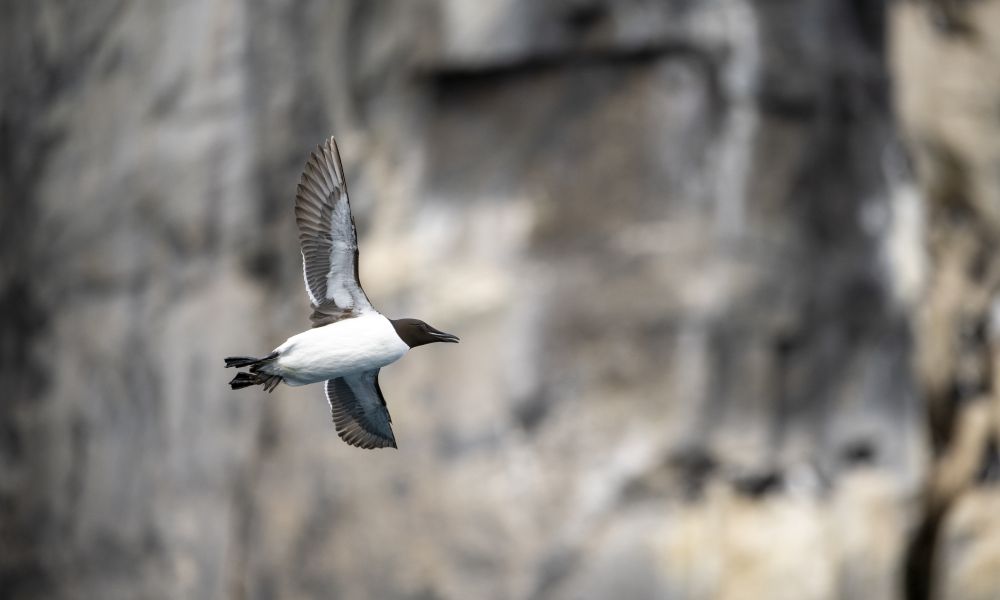
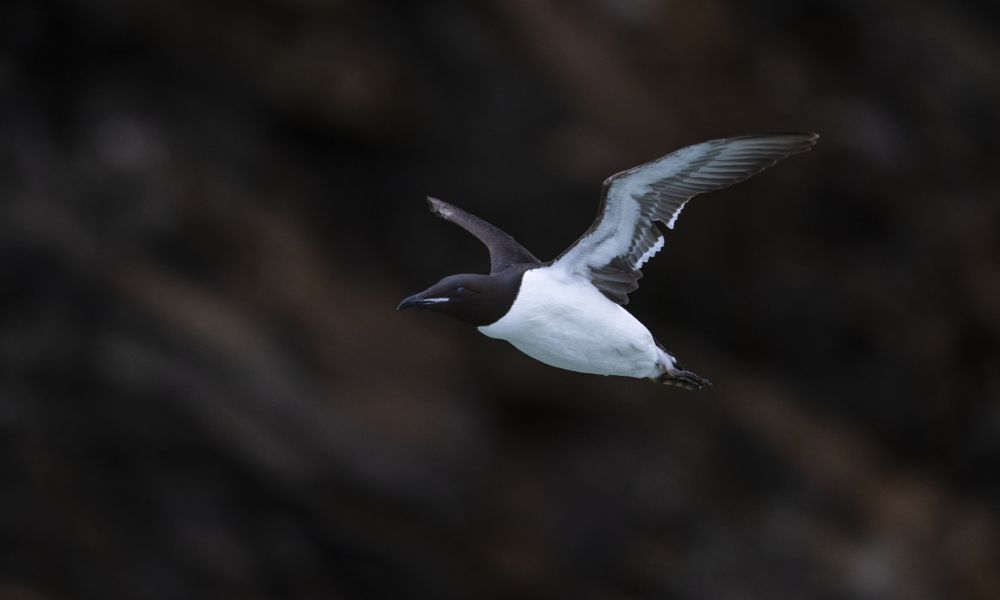
The Brünnich’s Guillemot is a stout, sturdily built black and white auk. One of the largest auks, measuring 40-44 cm long, with a wingspan of 64-75 cm and weighing between 800 and 1,100 g, where the male is the largest. It is black on the upper side and white on the underside, while the pointed beak is strong and with white edges. Its legs and feet are grey and can be seen behind the tail in flight.
What are the differences between the thick-billed murre vs. common murre?
The Brünnich’s Guillemot is distinguishable from the Common Guillemot by its shorter and thicker bill, which has a white line along the sides of the upper mandible, and by the absence of dark mottling on the flanks. In breeding plumage, the head, neck, and back are black, while the underparts are white. The white breast forms a narrow wedge towards the dark foreneck. In winter plumage, the neck and throat are white, but contrary to the Common Guillemot, the darker coloring of the head extends well below the eye and down to the cheeks. The juvenile resembles the adult in winter plumage, but its bill is smaller.
How deep can they dive?
The birds typically dive up to 140 ft, though they can reach depths of 400 ft. They use their wings like underwater flippers, propelling them downward with rapid strokes.
What do they like to eat?
Do they have any enemies?
How have they adapted to the Arctic?
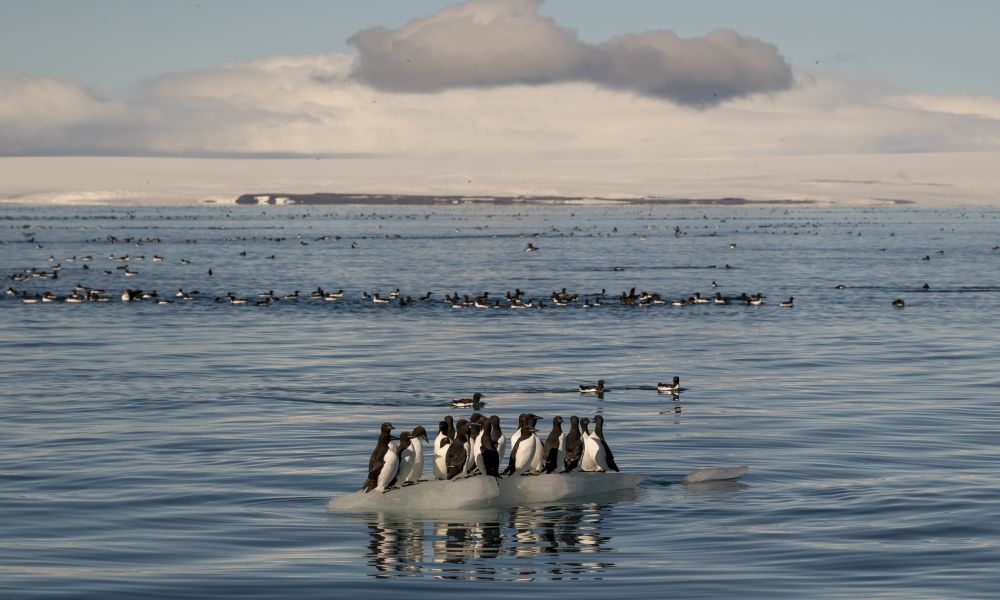
The Brünnich’s guillemot is built for cold water. Its body retains heat efficiently, and its wings serve double duty, propelling the bird through the water column with the same power they use in flight. This lets them reach the depths where Arctic cod, squid, and other cold-water prey concentrate, including along the sea-ice edge, where food is often most abundant.
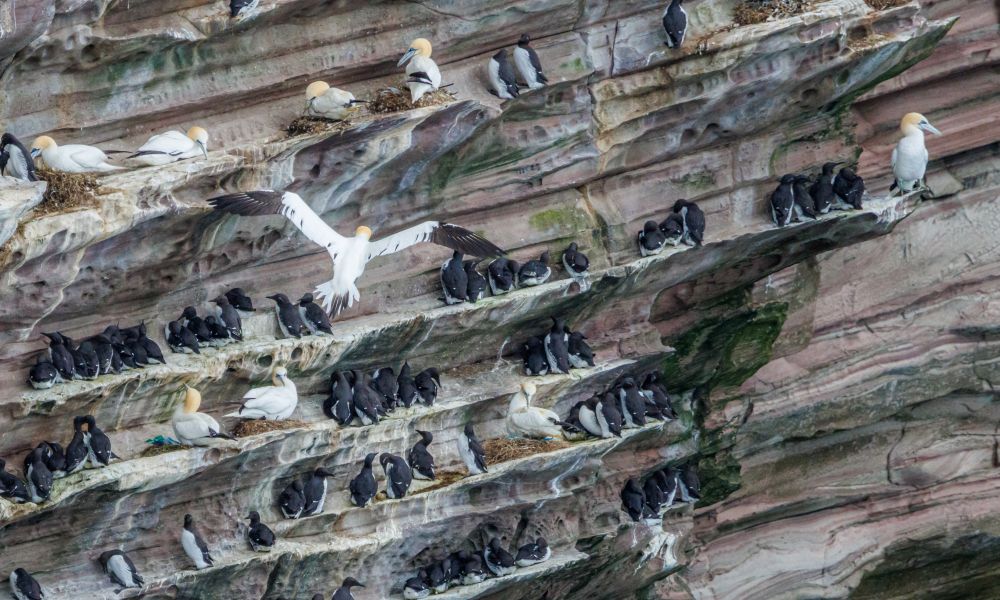
On land, they nest in dense cliff colonies. The crowding makes it harder for predators to isolate a single nest. When a chick is ready to leave, it goes before it can fly, leaping from the ledge to cut the time it spends exposed. The father meets it on the water below.
What do you call this animal?
| English | Brünnich’s Guillemot / Thick-billed Murre |
| Danish | Polarlomvie |
| Chinese | 厚嘴海鸦 (Hòu zuǐ hǎiyā) |
| Swedish | Spetsnäbbad simfågel |
| Finnish | Paksunokkaliitäjä |
| Norwegian | Polarlomvi |
| Polish | Nurzyk grubodzioby |
| Japanese | ハシブトウミガラス (Hashibuto-umigarasu) |
| Spanish | Arao de Brünnich / Arao de pico grueso |
| French | Guillemot de Brünnich / Guillemot à bec épais |
Want to see Brünnich’s Guillemot in the wild?
Reach out to our team to learn more about our voyages any time!