
Rock Ptarmigan
On the upland plateau above Longyearbyen, or across the rocky flats near Kangerlussuaq, the trick is to stop moving and look carefully at the ground. What appears to be a scatter of pale stones will occasionally shift. The rock ptarmigan is one of the Arctic’s most accomplished camouflage artists, and it needs to be. It is the only land bird that overwinters in Svalbard, and one of the few that remains in Greenland through the polar night, surviving on feathered feet and a coat that changes color three times a year.
Rock Ptarmigan At a Glance
| Scientific Name | Lagopus muta |
| Population | Estimated over 8 million globally |
| Regions | High Arctic and sub-Arctic across Eurasia, North America, and Greenland |
| Destinations | Svalbard, Greenland, Iceland, Canada, Norway |
| Average Length | 31–38 cm (12–15 in) |
| Average Weight | Males: 650–750 g (1.4–1.7 lbs); Females: 500–600 g (1.1–1.3 lbs) |
| Diet Habits | Buds, leaves, berries, seeds, and insects |
Did You Know
The genus name Lagopus comes from the Greek for “rabbit-footed.” The reference is to the ptarmigan’s heavily feathered feet, which work like snowshoes, distributing the bird’s weight across soft snow and insulating it from frozen ground.
Field Notes: Behavior & Biology
What does a rock ptarmigan look like?
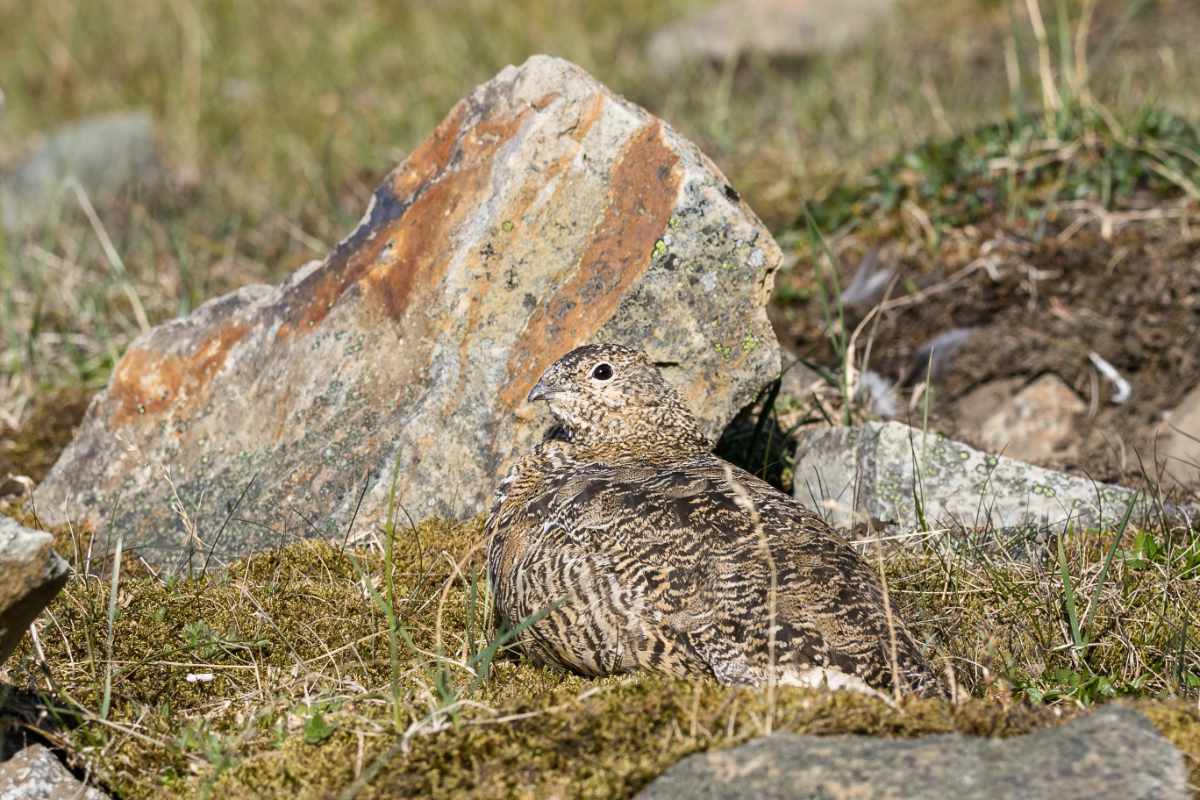
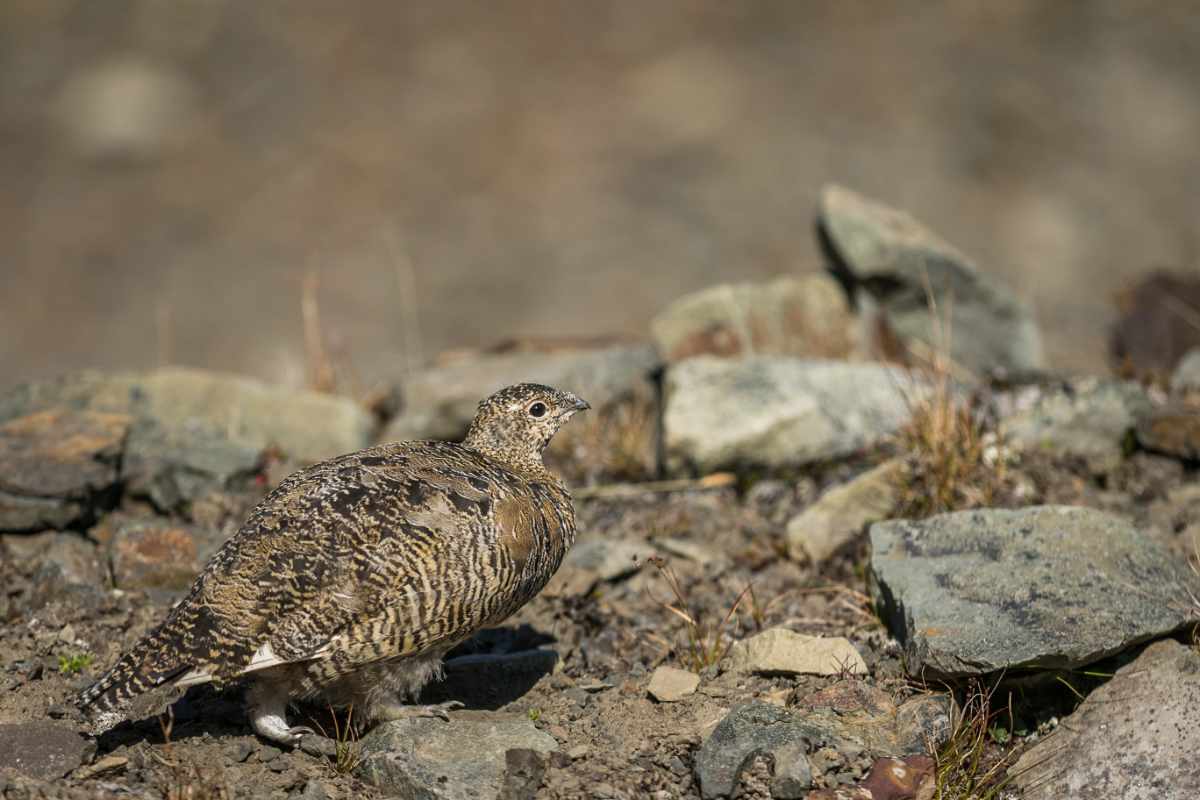
The rock ptarmigan is a compact bird with a round body, small head, short rounded wings, and legs feathered all the way to the toes. The plumage is what sets it apart. It goes through three distinct changes each year, each matched to the landscape.
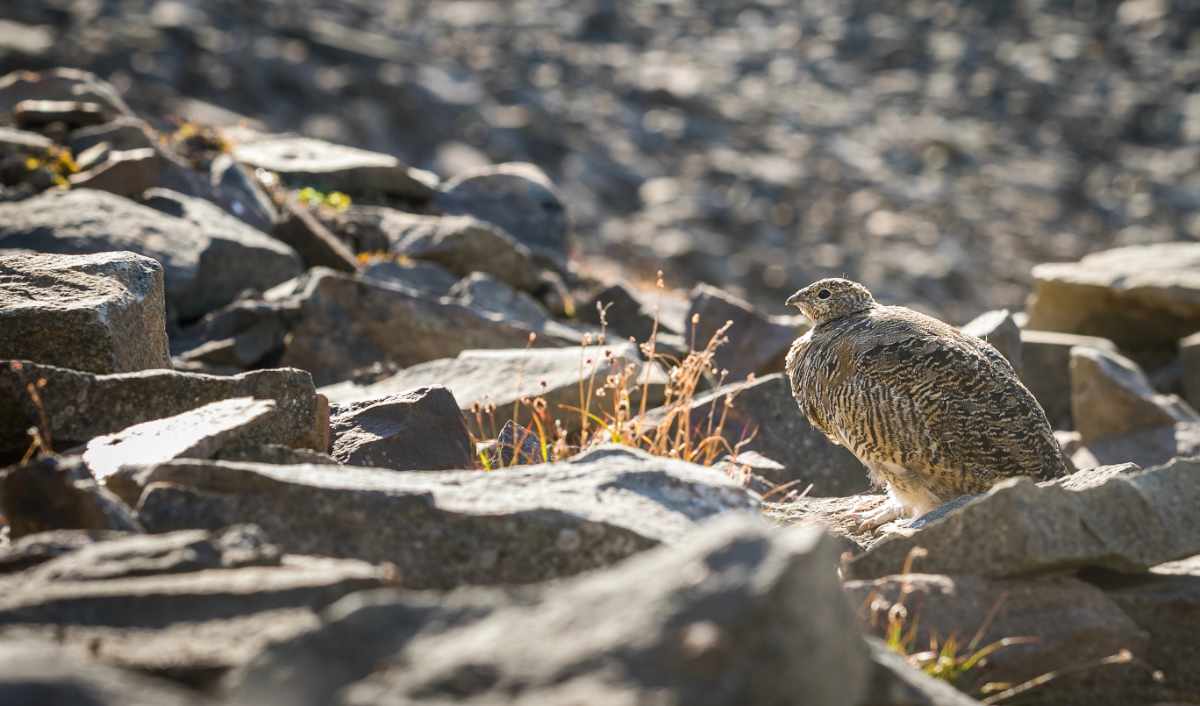
In winter, both sexes are almost entirely white, with a black tail and black bill. Males carry a narrow black line from the bill through the eye. In summer, females turn a rich brown and black. The coloring is ideal cover when sitting motionless on a ground nest. Males keep white wings and flanks against a gray-brown back and display a vivid red eyebrow comb during the breeding season. In autumn, both sexes shift to a speckled gray intermediate plumage before the winter white returns.
Where do they live?
Rock ptarmigan favor open, rocky terrain: upland tundra plateaus, high mountainsides, and the zone where vegetation gives way to bare scree. Their range runs across the high Arctic and sub-Arctic: Iceland, Svalbard, Greenland, northern Canada, and Alaska. Isolated mountain populations also exist in the Alps, Pyrenees, and Scotland.
In Svalbard, the rock ptarmigan is the only land bird to overwinter. In Greenland, it is one of the very few. Some Greenland populations make seasonal movements of several hundred kilometers between summer and winter ranges. Svalbard birds tend to stay put, shifting to lower, more sheltered ground when conditions become severe.
How have rock ptarmigan adapted to Arctic conditions?
The three-phase plumage cycle is the most visible adaptation, but the insulating properties of the feathers matter just as much as the color. Very few birds are feathered all the way to the toes. It reduces heat loss from the extremities and provides grip and flotation on snow.
When temperatures drop sharply, ptarmigan burrow into soft snow to roost overnight. A bird can maintain a livable microclimate inside a snow drift even when the temperature outside falls well below freezing. This behavior is shared by a few other Arctic grouse species, but the rock ptarmigan relies on it heavily through the long winter.
The seasonal plumage change is triggered by shifts in day length rather than temperature. As daylight shortens in autumn, the molt begins. It reverses as spring arrives. The timing is finely tuned. Populations at different latitudes shift at slightly different rates, each keyed to its own local day-length signal.
What do they eat?
Rock ptarmigan are primarily vegetarian. In summer they feed on buds, leaves, berries, and seeds. Females also take insects during the breeding season, when protein demand is higher. In winter, when snow covers most preferred plants, they shift to buds, shoots, and woody plant material. They are slow, deliberate feeders through the cold months, burning as little energy as possible.
How do rock ptarmigan breed?
Males establish territories in spring and display from prominent rocks, raising their red eyebrow combs and fanning their tails. After pairing, the female chooses a nest site on the ground, usually tucked among rocks or low vegetation. Clutch size ranges from 3 to 12 eggs. The female incubates alone for about three weeks. Chicks are precocial. They leave the nest within hours of hatching and are flying within two weeks, one of the fastest turnarounds for a bird of this size.
Who are their predators?
Camouflage is the first line of defense. A ptarmigan sitting still against a matching background is extremely difficult to spot, and the instinct to freeze rather than flush is strong. When flushed, flight is fast, alternating rapid wingbeats with gliding, and birds drop back to the ground quickly.
Main predators include Arctic foxes, gyrfalcons, rough-legged hawks, glaucous gulls, and Arctic skuas. Snowy owls take ptarmigan where their ranges overlap. Roosting in groups through winter adds protection. More birds watching means threats are spotted sooner.
Are rock ptarmigan endangered?
Rock ptarmigan are classified as Near Threatened on the IUCN Red List, with a global population estimated at over 8 million. Numbers have declined across parts of the range, particularly mountain populations at lower latitudes. Climate change is altering snow timing and depth, which affects both camouflage and roosting. Warmer conditions are also pushing predator species into habitats they previously couldn’t reach.
What does the scientific name mean?
Lagopus is Greek for “rabbit-footed,” a reference to the feathered feet. Muta is Latin for “silent” or “mute.” Rock ptarmigan are generally quieter than their relatives, with vocalizations mostly limited to the breeding season. The common name comes from the Scottish Gaelic tàrmachan. It passed into English as “ptarmigan” in the 17th century, with a silent “p” added by scholars who mistakenly assumed a Greek root.
What do you call this animal?
| English | Rock Ptarmigan |
| Danish | Fjeldrype |
| Chinese | 岩雷鸟 |
| Swedish | Fjällripa |
| Finnish | Kiiruna |
| Norwegian | Fjellrype |
| Polish | Pardwa górska |
| Japanese | ライチョウ (Raichō) |
| Spanish | Perdiz nival |
| French | Lagopède alpin |
Want to see rock ptarmigan in the wild?
Reach out to our team to learn more about our voyages any time!