
Arctic Hare
The Arctic hare is a fascinating animal to watch during our Greenland expeditions. As white as snow or as brown as the tundra rocks, this small herbivore is fully adapted to Arctic life. Look for snow holes or them standing up on their hind legs peeking up from rocks.
Arctic hare At a Glance
| Scientific Name | Lepus arcticus |
| Population | widespread |
| Regions | Arctic |
| Destinations | Greenland, Canada |
| Average Length | 55-60 cm; 22-24 inches |
| Average Weight | 2.5-5.5 kg; 6-12 lbs |
| Diet Habits | They primarily feed on woody plants such as Arctic willow, grasses, mosses, lichens, and other Arctic vegetation. |
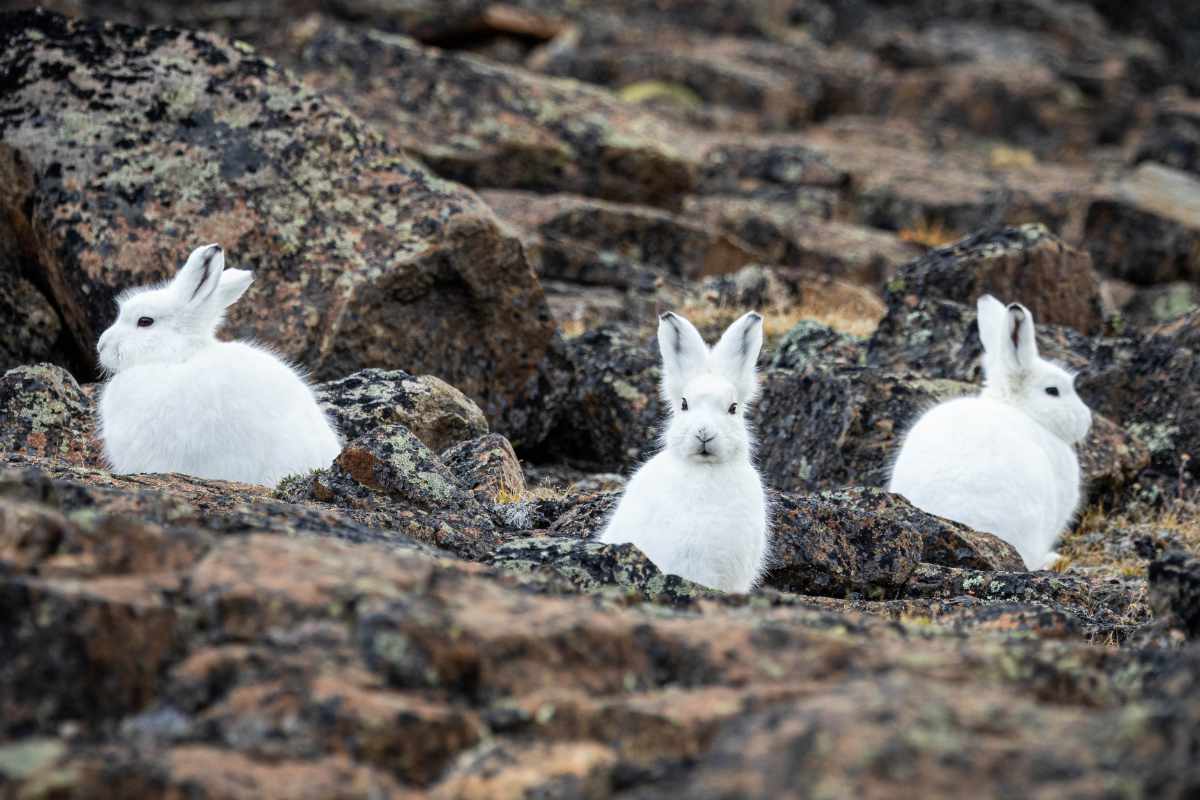
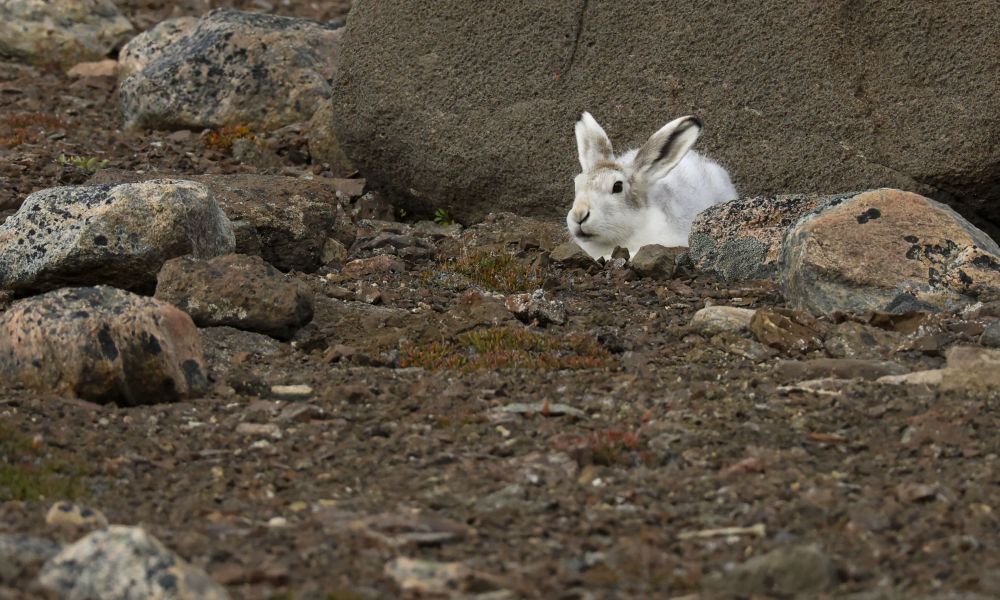
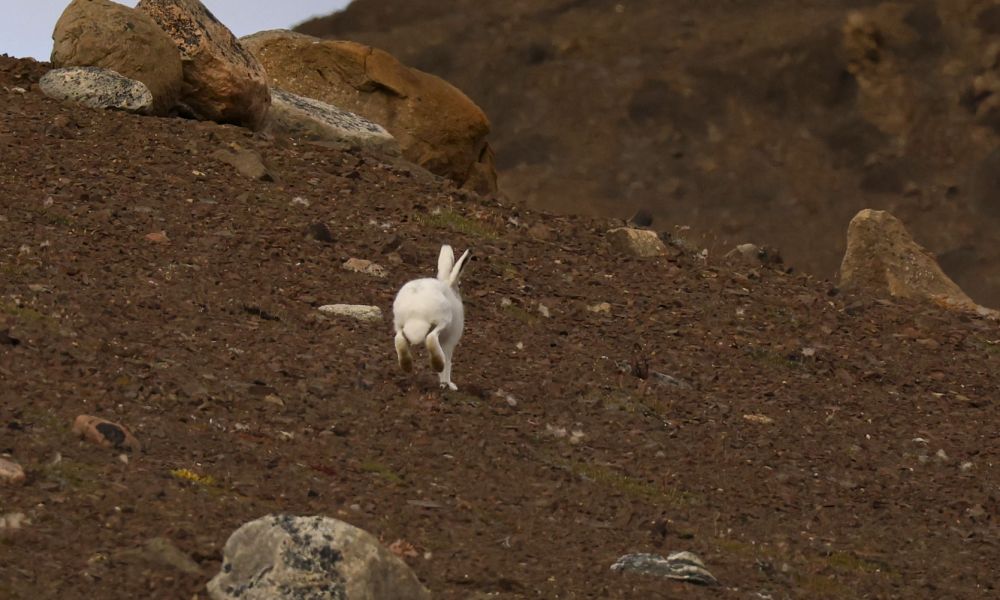
Did You Know
During the harsh winters, Arctic hares will form groups, sometimes in the hundreds. They will be loosely scattered about, with sentries keeping watch. When food becomes more abundant and it warms up, the groups disperse into smaller family units.
Field Notes: Behavior & Biology
Hares vs. Rabbits
While you may think these two animals are the same, they are not. They belong to the same family. Hares typically weigh more and have longer hind legs. This build helps them run faster than rabbits. Hares can run as fast as 40 mph vs. a rabbit’s 35 mph. And hares are born with fur and can see. Rabbits are born blind and hairless.
How do they adapt to the Arctic?
To help adapt to the harsh conditions, these hares have some differences:
- They have 20% body fat
- They have a double-layer of insulating fur
- They have fur-padded paws that help them run on snow
- Their ears are shorter than other hares, such as European hares, to prevent heat loss
Do they hibernate in the winter?
Do they have any enemies?
Yes, which is why they always scan their surroundings. They are on the lookout for Arctic foxes as well as birds of prey such as gyrfalcons and snowy owls. Polar bears have occasionally been observed eating hares.
Can they jump?
Absolutely. Because of their strong hind legs, they can jump several feet if not more. This is helpful when evading predators.
What do you call this animal?
| English | Arctic Hare |
| Danish | Polarhare |
| Chinese |
北极兔 (Běi jí tù)
|
| Swedish |
Fjällhare
|
| Finnish |
Napajänis
|
| Norwegian | Polarhare |
| Polish |
Zając arktyczny
|
| Japanese |
北極ウサギ (Hokkyoku usagi)
|
| Spanish |
Liebre ártica
|
| French |
Lièvre arctique
|
Want to see Arctic hares in the wild?
Reach out to our team to learn more about our expeditions at any time!